Reflections on The Red Cliff Rhapsody
"I can say that Su Dongpo was an incorrigible optimist, a great humanist, a friend of the people, a great writer, great calligrapher, original painter, experimenter in wine, engineer, hater of puritanism, yogi, Buddhist, Confucian statesman, secretary to an emperor, genial judge, political dissenter, moonlit wanderer, poet, and clown. But that still does not tell the whole of Su Dongpo. When Chinese people speak of Su Dongpo, they always smile with warmth and affection. That, perhaps, says the most about him."
— Lin Yutang
A Brief Retelling of the Text
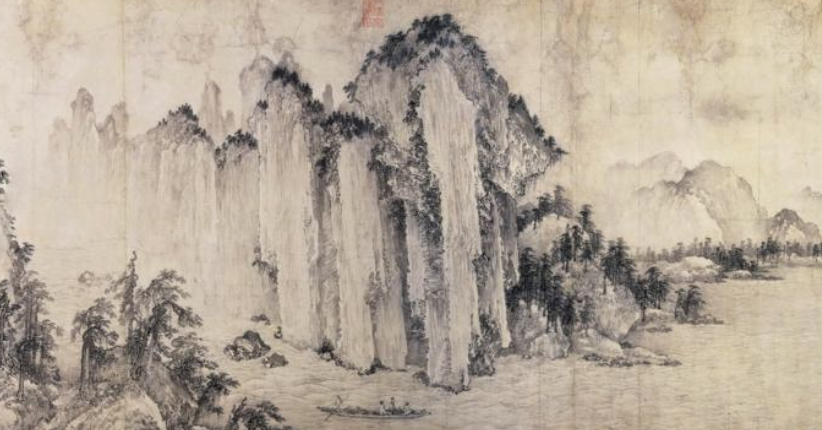
In the autumn of the year Renxu, on the night after the full moon of the seventh month, Su Shi and his friends took a boat beneath the Red Cliff. A gentle breeze stirred the air; the river lay calm. Raising wine cups, they recited poems about the moon and sang verses of grace and longing. Before long, the moon rose above the eastern hills, drifting between the constellations. Dew stretched across the river, and water merged with the sky. They floated with the current as though gliding through endless emptiness, as if riding the wind beyond the mortal world.
At the height of their joy, one guest began to sing while tapping the side of the boat. Another responded with the sound of a flute. Its tone was mournful and lingering, like complaint, like longing, like weeping. It could make hidden dragons dance in deep ravines and widows weep alone in small boats.
Su Shi straightened his robe and asked why the music sounded so sorrowful. The guest replied by recalling Cao Cao and the rise and fall of heroes. Once, mighty generals commanded fleets that covered the river. Now they were gone. And compared with them, what were ordinary people but fishermen and woodcutters on the riverbank, drifting like mayflies between heaven and earth, like grains of millet in the vast sea? Human life is brief; the river is endless.
Su Shi answered from a different angle. Water flows on, yet it is never truly gone. The moon waxes and wanes, yet it never disappears. If we look at things through the lens of change, even heaven and earth cannot last for an instant. But if we look through the lens of what endures, then all things, and the self, are without end. Why envy permanence elsewhere? The clear wind over the river and the bright moon in the mountains belong to no one, yet anyone may enjoy them. They are treasures without limit, shared freely by all.
The guest smiled. They washed their cups and drank again until the food was gone and the plates lay in disorder. Resting together in the boat, they did not notice when dawn arrived in the east.
Su Shi in Danzhou
I recently went to the Hainan Provincial Museum in Haikou specifically to see an exhibition on Su Shi.
During the Song dynasty, Hainan was known as Danzhou, the place Su Shi reached in the final stage of his life in exile. It is also the place referenced in one of his most famous lines:
"My heart is like dead ashes, my body like an unmoored boat. Ask what I accomplished in this life: Huangzhou, Huizhou, Danzhou."
In the spring of 1097, Su Shi was already in exile in Huizhou when two lines of his poetry angered his political enemies. Soon after, he was demoted again and sent even farther south, this time to Hainan. He departed in April, crossed the sea in June, and finally arrived in Danzhou in July.
Life there was harsh. Su Shi once described it this way: no meat to eat, no medicine when sick, no proper house, no friends nearby, no charcoal in winter, and no cool spring in summer. Yet he did not give up. He helped improve local wells and water access, paid attention to education, and left a deep mark on Hainan's cultural life.
Standing there today, on land transformed by highways, glass towers, and traffic, it is obvious that almost everything on the surface has changed. But the soil still seems to remember.
Between Change and the Unchanging
I stood in front of The Red Cliff Rhapsody for an hour and a half.
People moved around me, but time seemed to pause. My thoughts went back to a Chinese literature class four years ago. That was the first time I had read the text in full, and yet I did not truly understand it. Back then, I focused mostly on the literal meaning because I needed to pass an exam. Reading it again now, after years of personal changes and emotional upheaval, I found that almost every line could strike directly into lived experience.
Over those four years, the world, the country, society, and I myself all changed in ways I could never have predicted. There was joy, happiness, and hope, but also confusion, loss, pain, and uncertainty.
As life grew not only longer but wider and heavier, I slowly came to understand what I now think is the central idea of The Red Cliff Rhapsody:
the only thing that does not change is change itself.
As Su Shi writes:
"If we look from the side of change, then heaven and earth themselves cannot last for even an instant; if we look from the side of what does not change, then all things and the self are endless."
From a Buddhist perspective, impermanence is the truth of existence. Birth and death, construction and collapse, arising and vanishing: nothing escapes the cycle. Nothing gets to refuse change.
And yet, once we recognize the nature of change, we may also discover a different kind of constancy inside it. That constancy is not control. It is the willingness to accept change itself.
For each individual, that insight can become a source of spaciousness when life goes wrong. But it is also, in a certain sense, a helpless kind of spaciousness.
The helplessness comes from realizing our limits. We are ordinary. Many things lie outside our control. We cannot command everything that happens to us.
But openness comes from accepting this truth honestly:
"Yes, I am ordinary. Yes, I am limited. I cannot control every part of life. Even so, I am still myself. I am unique, and I love that self, and I love the people and things I truly care about."
Alfred
Written at the Hainan Provincial Museum, Spring 2024