Crossing the Chasm: Where 90% of Startups Fail
Introduction
High-tech entrepreneurship is easy to romanticize: the dream of changing the world, the intellectual intensity, and the possibility of enormous upside.
Since the 1960s, we have seen wave after wave of ambitious founders take this road. A small minority reshaped the world. Most did not.
Why do so many startups fail even after a promising beginning?
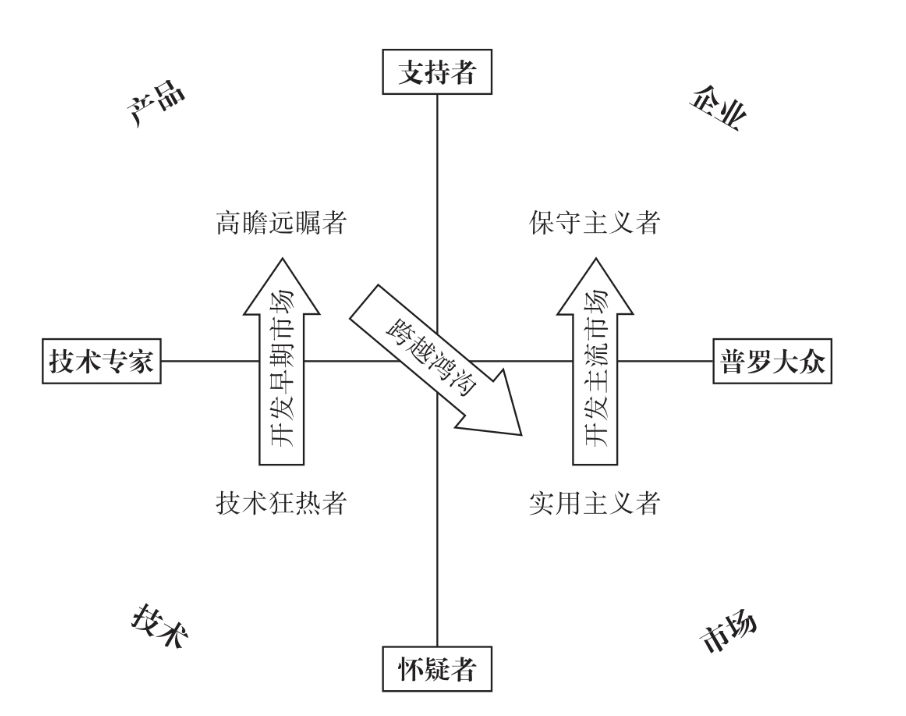
One major reason is that innovative products often succeed first with a small group of technology enthusiasts and visionaries, but then fail when they try to enter the much larger mainstream market. Between those two stages lies a deep and dangerous gap:
the chasm.
Many failed startups follow the same narrative. Their products get strong early attention. Technologists love them. Early adopters buy into the vision. Investors and media show interest. Then growth suddenly stalls. Mainstream buyers do not convert. Sales flatten, cash burn continues, and the company eventually dies.
The problem is not always that the product is technically bad. Often the deeper problem is that founders fail to understand that early adopters and the early mainstream are fundamentally different kinds of customers.
One group wants breakthrough potential. The other wants proven reliability. One tolerates imperfection. The other expects a complete solution.
That is why crossing the chasm is one of the central strategic challenges in building a technology company.
The Chasm
Technology products do not get adopted by the whole market all at once. Adoption usually follows a sequence, often called the technology adoption lifecycle:
- innovators
- early adopters
- early majority
- late majority
- laggards
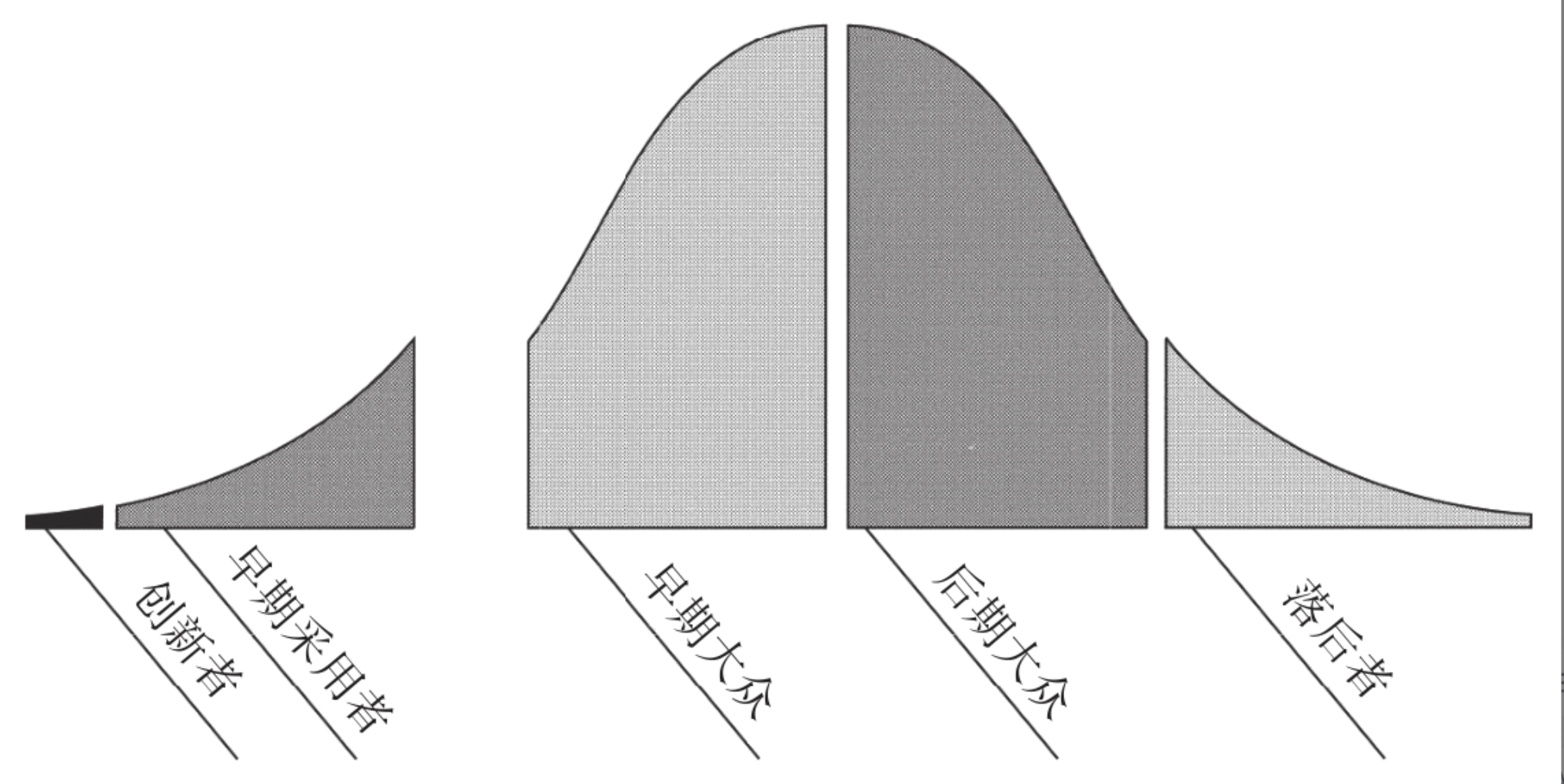
Each group has different motivations, risk tolerance, and decision logic.
Who are these groups?
Innovators
Innovators are technology enthusiasts. They love novelty for its own sake. They want access early, even before the product is polished. They care less about completeness and more about technological possibility.
Early adopters
Early adopters are visionaries. They are not necessarily hardcore technologists, but they are willing to take high risk for strategic breakthrough. They can buy based on intuition and ambition. They are looking for transformation.
Early majority
The early majority are pragmatists. They do not want experiments. They want a solution that already works, preferably one validated by similar people or organizations. They care about productivity, reliability, and referenceability.
Late majority
The late majority are more conservative still. They adopt once a technology has become standard and low-risk.
Laggards
Laggards resist adoption as long as possible and often enter only when alternatives disappear.
The key strategic goal for most startups is obvious:
they want to move beyond the niche excitement of innovators and early adopters and win the mainstream.
But that transition is exactly where the chasm appears.
Why the chasm exists
The core reason is that early adopters and the early majority operate with different value systems.
Early adopters
- want revolutionary upside
- are willing to tolerate risk
- do not need strong precedent
- can decide on intuition and vision
Early majority
- want practical value
- are risk-averse
- need case studies and peer validation
- prefer a whole, proven solution
That difference creates a structural problem:
the early majority want proof from people like themselves, but those proof points do not exist until the early majority have already started buying.
This is the market trap at the center of the chasm.
If a company fails here, the result is usually brutal:
- growth slows sharply
- the energy of the early market fades
- investors lose confidence
- cash flow deteriorates
- competitors move in
At that point, crossing the chasm is no longer a growth challenge. It becomes a survival challenge.
Crossing the Chasm as D-Day
Geoffrey Moore uses a powerful military analogy: the Normandy landing on D-Day.
The basic logic is this:
if you want to take a heavily defended continent, you do not attack everywhere at once. You concentrate overwhelming force on one strategically important beachhead, secure it, and then expand outward.
The same logic applies to startups entering the mainstream market.
Your long-term goal is to conquer a broad market already influenced or controlled by stronger incumbents. But to do that, you first need one defensible beachhead: a tightly defined target segment where you can build credibility, references, and momentum.
In this analogy:
- the early market is Britain
- the mainstream market is continental Europe
- the chasm is the English Channel
- the target niche is Normandy
- your product and partners are the Allied forces
The core strategic rule is:
focus all available force on one beachhead segment and establish a position strong enough to expand from there.
Moore's tactical logic can be broken down into four steps:
- choose the point of attack
- assemble the assault force
- define the battlefield
- launch the attack
Choose the point of attack
Choosing the target market really means choosing a target user and, more specifically, a target use case.
Do not begin by asking, "What giant market should we enter?"
Begin by asking:
In what concrete situation does someone urgently need what we provide?
The most useful template looks like this:
A day in the life before the new product
- What situation creates frustration?
- What result is the user trying to achieve?
- How do they currently try to solve it?
- What fails in that process?
- What is the economic consequence of that failure?
A day in the life after the new product
- How does the user now solve the task?
- What does the product make possible that was previously difficult?
- What cost is reduced or what gain is created?
Once you have such a use case, you can evaluate whether the segment is a real beachhead. Moore emphasizes four factors:
Target customer
Is there a clear economic buyer, reachable through a practical sales channel, with budget to buy the full solution?
Compelling reason to buy
Is the pain severe enough that a rational buyer urgently wants to solve it now, rather than tolerate it for another year?
Whole product feasibility
Can your company, with partners if needed, deliver a complete enough solution within a short time frame?
Competitive timing
Has someone else already crossed the chasm in that segment and taken the beachhead before you?
Assemble the assault force
Once the beachhead is identified, the next task is to build enough force to take it. Moore calls this the whole product.
The logic is simple:
the product you promise in marketing is not the same as the product the customer must actually have in order to succeed.
The gap between those two is where startups often lose.

Think about buying an iPad.
The physical tablet is the generic product. But for the user to actually achieve their goal, much more is involved:
- charging accessories
- software ecosystem
- support
- app compatibility
- stylus
- cloud sync
- workflows
That larger system is the whole product.
Crossing the chasm requires more than selling a core innovation. It requires delivering an end-to-end solution that solves the customer's real problem.
Startups usually cannot build all of that alone. That is why tactical alliances matter. Partners, service providers, distributors, integration layers, and complementary products can all be part of the assault force.
If the customer's urgent problem is not fully solved, then the beachhead is not truly captured.
Define the battlefield
By this point, the startup has:
- chosen a beachhead
- identified a compelling use case
- prepared a whole-product strategy
Now comes the next question:
Who exactly are we competing against, and how should we position ourselves?
Pragmatists do not like ambiguity. They actually welcome competition because competition gives them a framework for comparison. That means startups should not fear competition. In a sense, they should create a competitive frame.
This is where positioning becomes central.
Positioning is not just clever marketing language. It is the place your company occupies in the customer's mind relative to alternatives.
For a company trying to cross the chasm, there are usually two kinds of competitors to think about.
The market alternative
This is what the customer uses today. It may not be a direct technological competitor, but it is where the budget currently goes.
You are not just competing with another startup. You are competing with the existing way the customer solves the problem.
The product alternative
This is another company building a similar disruptive product. Its existence helps validate the category, but you still need to differentiate from it, especially around the niche segment you are targeting.
This leads to a critical insight:
If your startup still communicates only in terms of product superiority, you may keep attracting early adopters. But that does not mean you will win the early mainstream.
Pragmatists care much more about market-centered value than product-centered value.
Product-centered value vs. market-centered value
Product-centered value sounds like this:
- our product is faster
- our architecture is cleaner
- our features are more advanced
- our technology is more elegant
Market-centered value sounds like this:
- we have the strongest installed base
- the ecosystem is deeper
- support is better
- implementation is lower-risk
- ownership cost is clearer
- compatibility is stronger
When crossing the chasm, the startup's messaging hierarchy must flip:
market-centered value first, product-centered value second.
In other words, the goal is not merely to make the product easy to sell. It is to make it easy to buy.
Common mistakes in positioning
Moore's framework also helps avoid several classic mistakes:
-
Positioning is not just a slogan
It is a structural attribute of the company and product, not a marketing trick. -
Positioning strongly shapes purchase decisions
It becomes the lens through which all other evaluation happens. -
Positioning exists in the customer's mind, not in your copywriting deck
You must use the buyer's familiar language and reference system. -
People are conservative about changing mental categories
The most effective positioning often requires the smallest cognitive disruption.
Conclusion
The core lesson of Crossing the Chasm is brutal but clear:
the journey from early believers to the mainstream is not continuous. It is discontinuous.
Technology startups often die not because the product lacks brilliance, but because the company mistakes early enthusiasm for mainstream readiness.
To cross the chasm, a startup must do three things well:
- identify one sharply defined beachhead segment with urgent pain
- build a whole product strong enough to solve that segment's real problem end to end
- position itself within a competitive frame that pragmatists can actually trust
Only then can a company move from a niche of believers into the larger, slower, more demanding world of the mainstream market.
This is why crossing the chasm is so hard.
And this is why so many startups never make it across.